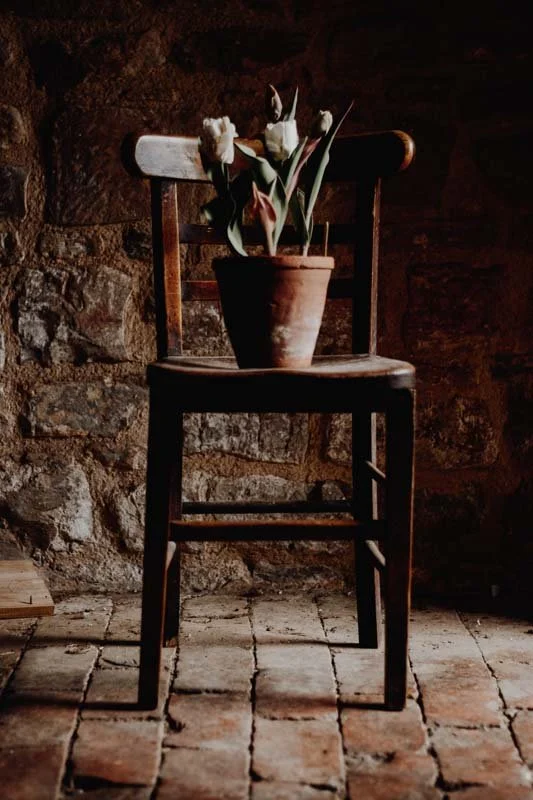
TULIPS IN POTS
Tulips in pots bring theatre to the doorstep or terrace, their flowers rising like painted goblets against bare stone and early blossom. Choose your varieties with intent rather than abandon. Early-flowering cultivars such as Apricot Beauty or Foxtrot will open in March; mid-season stars like Ballerina and Menton carry the show through April; and the late performers, Queen of Night or Spring Green, take the final bow in May. Limiting each container to one or two colours gives the display coherence — tulips, like divas, do not like to share the spotlight.
Select a deep, heavy pot. At least thirty centimetres across but essentially, as large as you can afford (and afford to fill) with generous drainage holes. Fill the base with crocks or gravel and use a free-draining mix of peat-free compost and horticultural grit. Tulip bulbs are happiest when planted deeply, about three times their own height. You can layer them, placing late varieties at the bottom, mid-season in the middle, and early types nearer the top — a horticultural lasagne that delivers waves of colour over many weeks. Water once to settle the compost and then forget them until the shoots appear in spring. Keep pots in a cold, sheltered place through winter; tulips love a chill.
TULIPS IN THE GROUND
In borders, tulips crave sunlight and soil that drains freely. If your garden is heavy with clay, lighten it with sand or leaf mould before planting. Set bulbs pointy side up at a depth of fifteen to twenty centimetres and space them around ten centimetres apart. For natural grace, group them in odd numbers (threes, fives, sevens) rather than rigid rows.
Now, the absolutely crucial bit is to keep the mice and the squirrels off. I find a few layers of fine chicken wire is the only thing that works I’m afraid. This is the year I learn to make chicken wire cloches (I’ll do a video when I’ve worked it out). Until then, we’ll have to buy them in. I fancy these.
Ok, that was the last big outdoors gardening job of the year. Pop a cork.